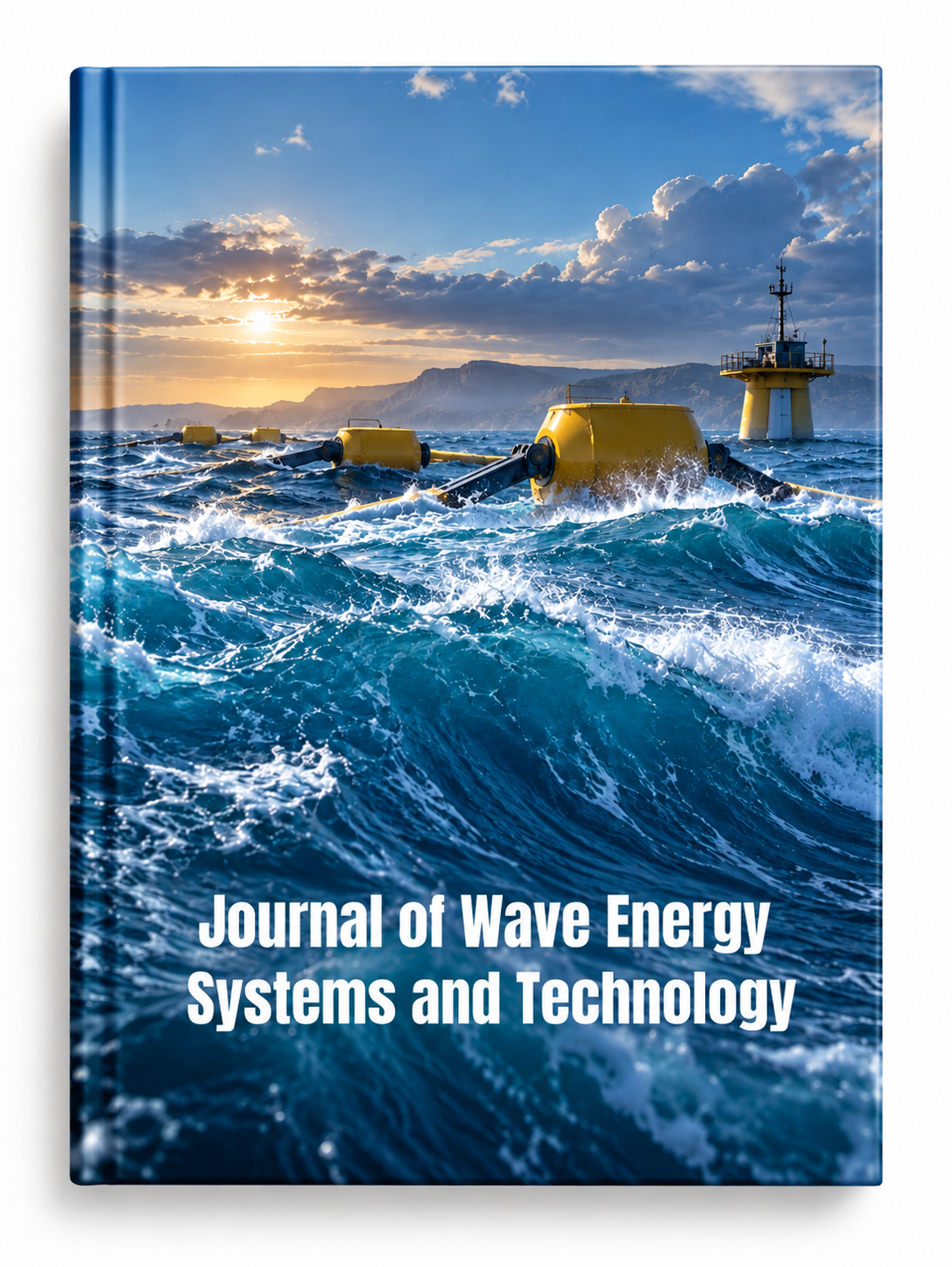
About the Journal


Journal of Wave Energy Systems and Technology (WEST) is an international peer-reviewed, open-access scholarly journal dedicated to advancing research and innovation in wave energy conversion, marine renewable energy systems, hydrodynamics, power take-off technologies, control strategies, reliability, digital monitoring, and sustainable marine energy deployment. The journal provides an interdisciplinary platform for researchers, engineers, technology developers, industry professionals, policymakers, and other stakeholders working in the field of ocean and wave energy.

WEST publishes theoretical, experimental, computational, technological, operational, and policy-oriented studies concerning wave energy converters, wave–structure interaction, power take-off systems, hydrodynamic performance, numerical modeling, laboratory testing, control and optimization, reliability, condition monitoring, digital technologies, resource assessment, deployment, grid integration, techno-economics, environmental impacts, and commercialization of wave energy technologies.

The journal particularly welcomes manuscripts that integrate hydrodynamic performance, engineering design, energy conversion efficiency, control, reliability, environmental responsibility, economic feasibility, and practical deployment. WEST encourages research that contributes to the development of efficient, reliable, scalable, and sustainable wave energy systems for future marine power generation.

Journal Identity
Wave Energy Conversion  ·  Marine Renewable Energy  ·  Hydrodynamics & Devices  ·  Control, Reliability & Sustainability
Advancing Wave Energy Technologies for Sustainable Marine Power

Focus and Scope

Journal of Wave Energy Systems and Technology publishes original research articles, review papers, experimental studies, numerical and computational research, technical contributions, conceptual studies, and policy-oriented research addressing wave energy technologies and marine renewable-energy systems. The journal particularly welcomes manuscripts within the following areas:

1. Wave Energy Conversion Systems and Devices
Wave energy converters, oscillating water columns, point absorbers, attenuators, overtopping systems, oscillating wave surge converters, floating and submerged devices, hybrid wave energy systems, power take-off systems, array configuration, converter architecture, energy capture, device performance, prototype development, and innovative wave energy technologies.
2. Hydrodynamics, Modeling and Experimental Technology
Wave–structure interaction, linear and nonlinear hydrodynamics, potential-flow modeling, computational fluid dynamics, numerical wave tanks, fluid–structure interaction, physical model testing, laboratory wave tanks, scale effects, response analysis, mooring interaction, structural response, performance prediction, and model validation for wave energy systems.
3. Control, Power Take-Off, Reliability and Digital Technologies
Power take-off control, optimal and predictive control, energy maximization, electrical and mechanical conversion systems, condition monitoring, sensors, digital twins, artificial intelligence, machine learning, fault detection and diagnosis, predictive maintenance, reliability engineering, availability, survivability, operational optimization, and intelligent wave energy systems.
4. Wave Energy Deployment, Sustainability and Marine Systems
Wave resource assessment, site characterization, array deployment, grid integration, offshore installation, mooring and anchoring, operation and maintenance, survivability, techno-economic assessment, levelized cost of energy, environmental impacts, marine spatial planning, policy and regulation, commercialization, lifecycle analysis, and sustainable deployment of wave energy technologies.
Interdisciplinary Studies: WEST welcomes interdisciplinary research involving ocean engineering, offshore engineering, naval architecture, mechanical engineering, electrical engineering, control engineering, materials science, artificial intelligence, environmental science, energy economics, marine policy, and related fields when the manuscript demonstrates a clear contribution to wave energy conversion, marine renewable-energy technology, deployment, performance, reliability, or sustainability.
Scope Note: Manuscripts focused primarily on generic hydrodynamics, offshore structures, coastal engineering, CFD, control systems, artificial intelligence, materials, or electrical systems should demonstrate a substantive connection to wave energy conversion, wave energy devices, marine renewable-energy systems, energy capture, deployment, reliability, or sustainable marine power generation to be considered within the scope of WEST.
WEST Perspective: The journal is particularly interested in research that connects wave-energy science and engineering with device performance, control, reliability, economic feasibility, environmental responsibility, and real-world deployment, supporting the transition toward sustainable marine energy systems.