Advancing Offshore Energy
Coupled Analysis of Hybrid FOWT-FSPV Platforms
Keywords:
Floating Offshore Wind Turbine, Floating Solar Photovoltaic, Hybrid Energy System, Hydrodynamic Response, Mooring SystemAbstract
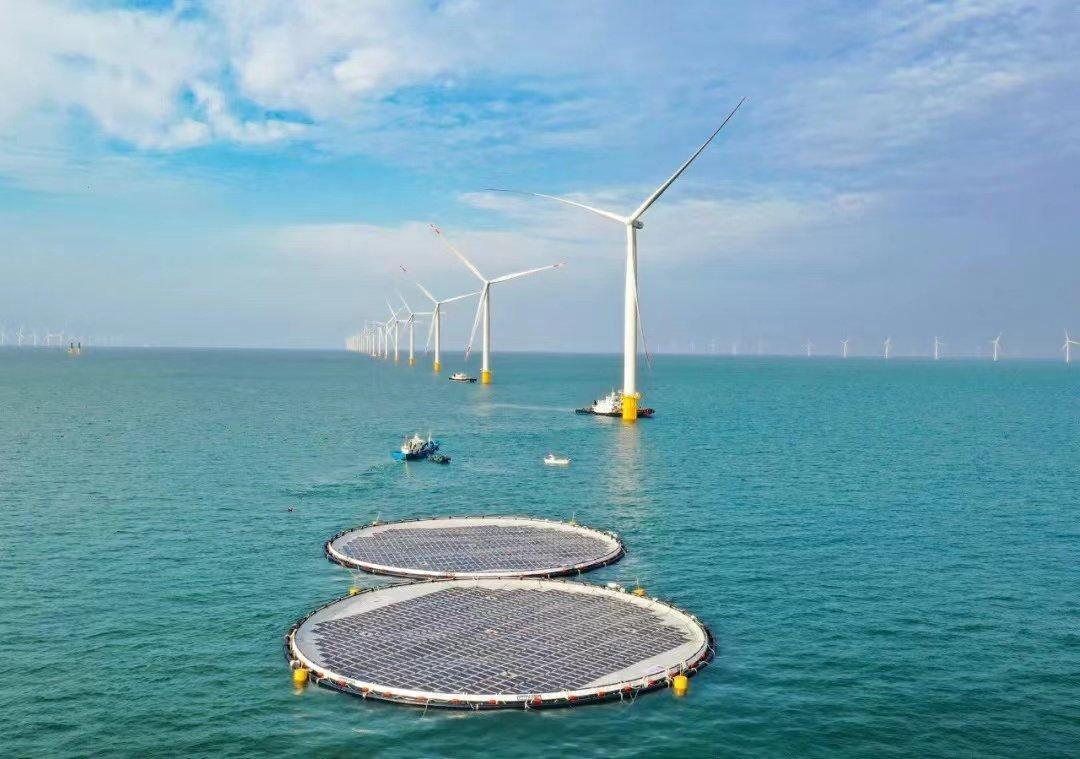
The transition to clean energy sources drives the optimal exploitation of offshore renewable energy potential. However, coastal space constraints and power output fluctuations from single energy sources present major challenges to its development. This study aims to analyze the technical performance, structural hydrodynamic response, and power generation efficiency of an integrated hybrid system combining a Floating Offshore Wind Turbine (FOWT) and Floating Solar Photovoltaics (FSPV). The research methodology employs numerical modeling to evaluate aero-hydrodynamic interactions and dynamic loading induced by wave and wind variations on the floating platform and mooring system. The analysis reveals that integrating FSPV onto the FOWT platform significantly increases total energy output capacity while optimizing marine spatial efficiency and subsea transmission cable infrastructure utilization. Furthermore, the designed mooring system configuration effectively mitigates the platform's dynamic motion responses, specifically in pitch and heave modes, thereby maintaining operational stability. This study concludes that the hybrid FOWT-FSPV system demonstrates high technical feasibility as a large-scale offshore renewable energy generation solution.
References
[1] J. Moore and G. Iglesias, “Hybridisation of offshore wind farms with floating photovoltaics: Power smoothing and output-demand divergence reduction,” Energy Convers. Manag., 2025, doi: 10.1016/j.enconman.2025.120413.
[2] R. Haider, W. Shi, Y. Cai, Z. Lin, X. Li, and Z. Hu, “A Comprehensive Numerical Model for Aero-Hydro-Mooring Analysis of a Floating Offshore Wind Turbine,” Renew. Energy, 2024, doi: 10.1016/j.renene.2024.121793.
[3] F. Superchi, R. Travaglini, and A. Bianchini, “Critical issues for the deployment of floating offshore hybrid energy systems comprising wind and solar: a case study analysis for the Mediterranean Sea,” Renew. Energy, 2026, doi: 10.1016/j.renene.2026.125194.
[4] J. Fu, Y.-P. Zhao, G. Jia, Chao, J.-Q. Shu, and Y. Sun, “Numerical study on wave–wind coupling effects on hydrodynamics and light capture performance of offshore multi-body floating photovoltaic system,” Ocean Eng., 2025, doi: 10.1016/j.oceaneng.2025.120593.
[5] L. Chen, J. Yang, and C. Lou, “Floating wind-integrated PV system yield analysis considering AHSE dynamics & solar azimuth effects,” Energy Convers. Manag., 2024, doi: 10.1016/j.enconman.2024.118799.
[6] E. Faraggiana et al., “Floating offshore wind potential for Mediterranean countries,” Heliyon, vol. 10, 2024, doi: 10.1016/j.heliyon.2024.e33948.
[7] Y.-C. Tang et al., “Dynamic analysis of multi-module floating photovoltaic platforms with composite mooring system by considering tidal variation and platform configuration,” Ocean Eng., 2024, doi: 10.1016/j.oceaneng.2024.119243.
[8] K. Zhu, H. Shi, J. Tao, H. Gong, Z. Han, and F. Cao, “Analytical study on hydrodynamic performance of co-located offshore wind–solar farms,” Phys. Fluids, 2024, doi: 10.1063/5.0187178.